




HSSE M35 Machine Taps and Drill for General Steel
High Speed Steel Spiral Point Tap (HSS-G, HSSE, DIN 371, DIN 376 M2-M24) for General Steel
Details of high-speed steel
6542 (W6Mo5Cr4V2): Tungsten-molybdenum high-speed steel is a general-purpose grade and one of the most common types available on the market, offering excellent value for money.
Key Chemical Components: (C):0.80-0.90%
(W):5.50-6.75%
(Mo):4.50-5.50%
(Cr):3.80-4.40%
(V):1.75-2.20%
M35 (W6Mo5Cr4V2Co5): Tungsten-molybdenum-cobalt super-hard high-speed steel is a high-performance steel grade that is widely used internationally.
Key Chemical Components: The top five similar as HSS6542 but add Co: 4.5-5.5%, Cobalt significantly improves the red hardness and high-temperature hardness of steel.
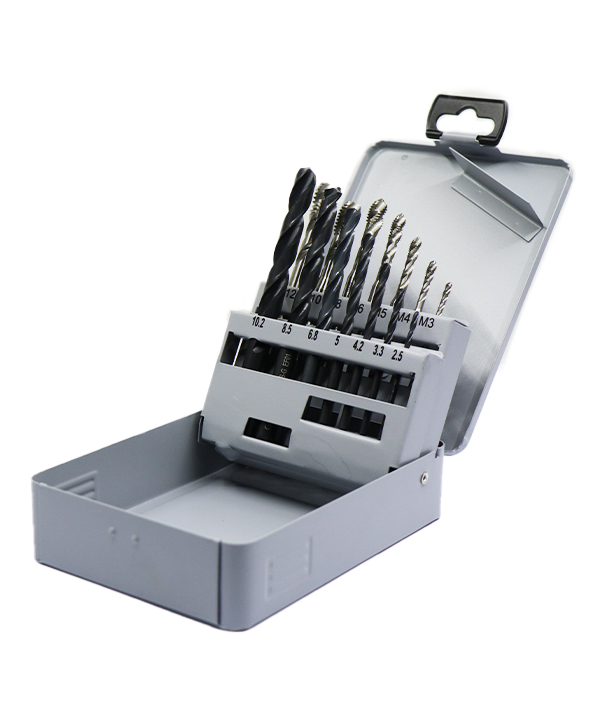
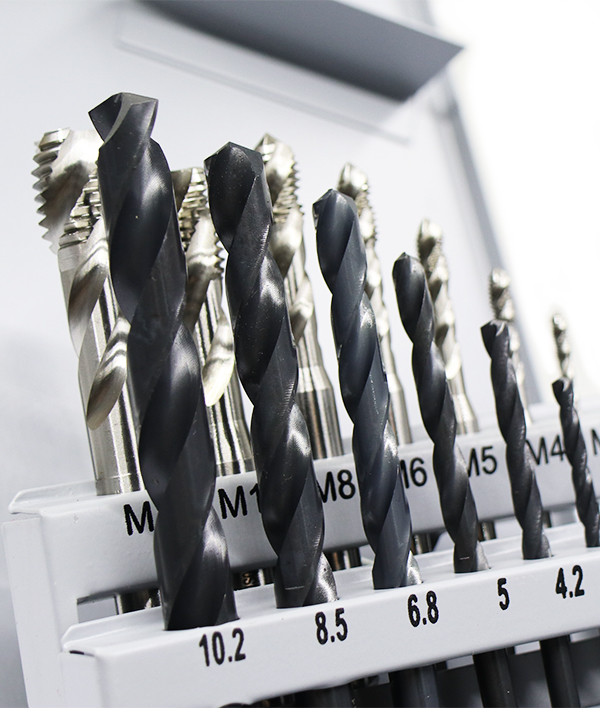
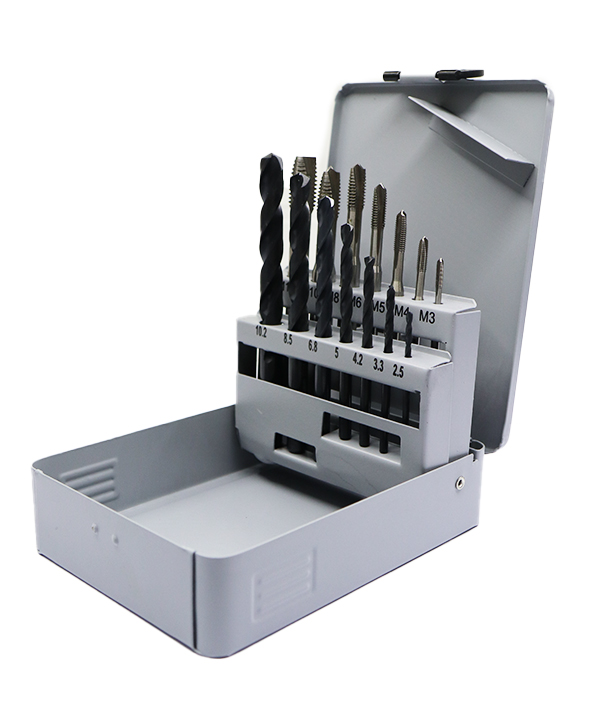
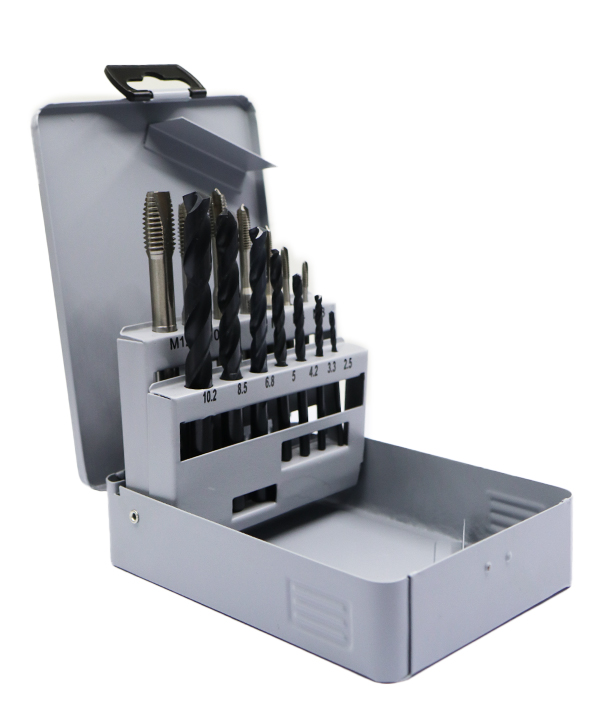
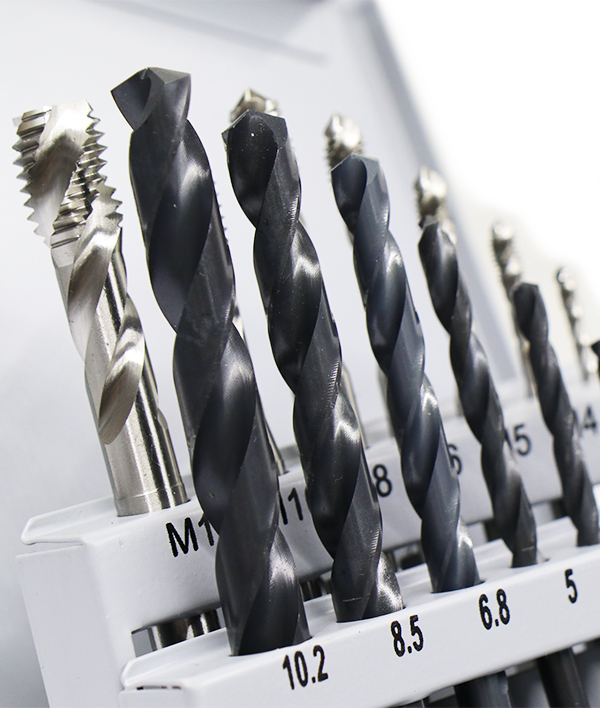
This is a set contains machine taps and drill bits, you can check details below:
Set 1
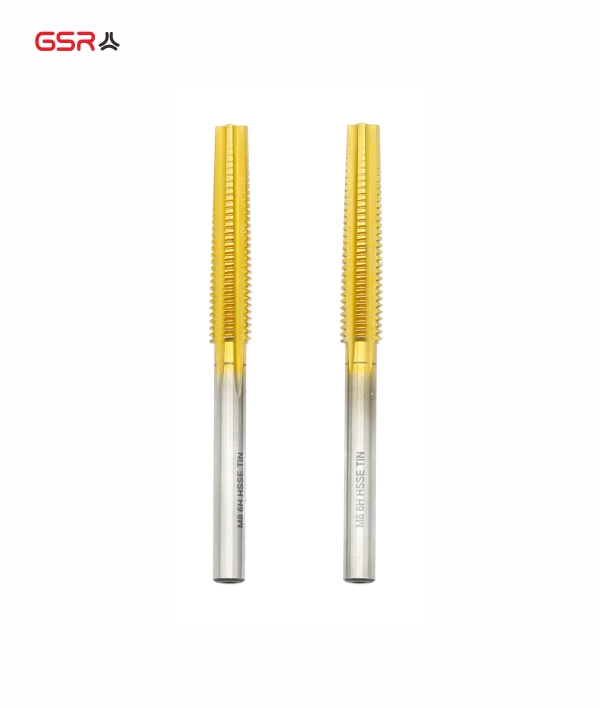
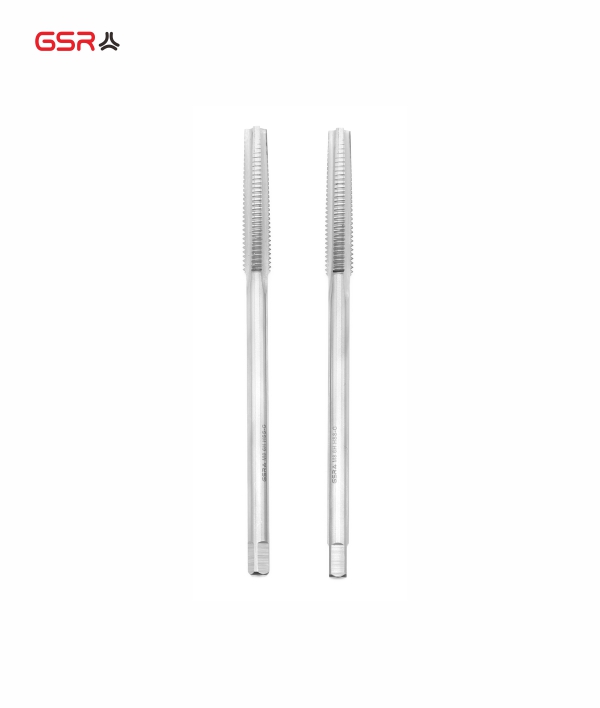
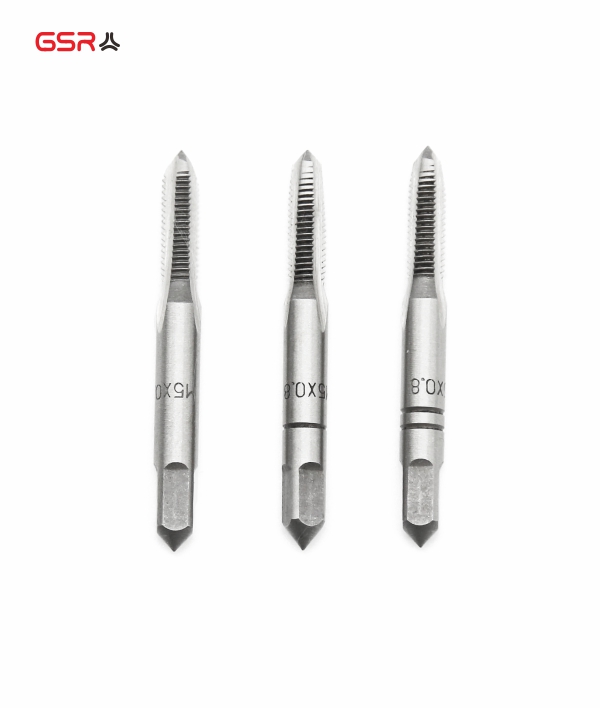
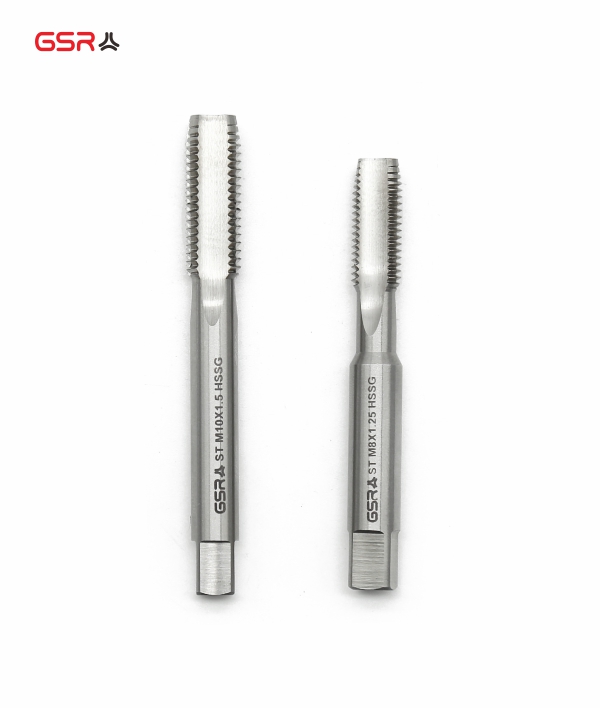
DIN371 machine tap, spiral point, M3-4-5-6-8-10, HSS, bright
DIN376 machine tap, spiral point, M12, HSS, bright
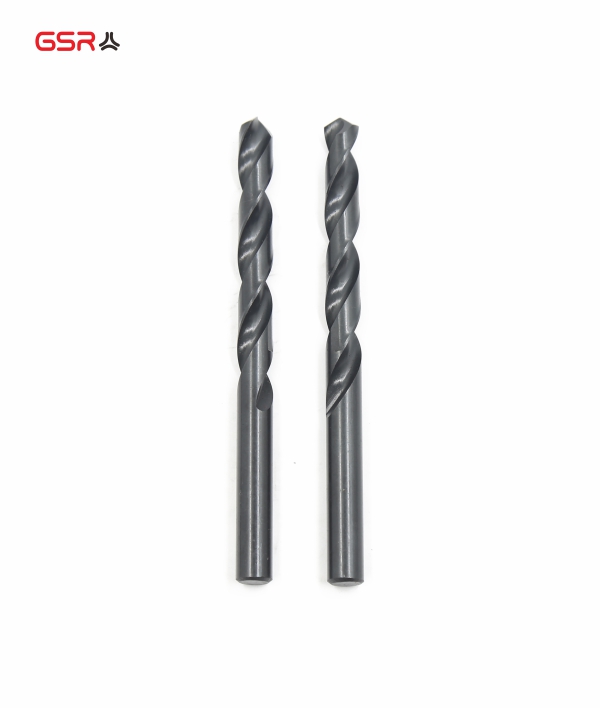
DIN338 twist drill bit, 2.5-3.3-4.2-5-6.8-8.5-10.2mm, HSS, Vaporized
Set 2
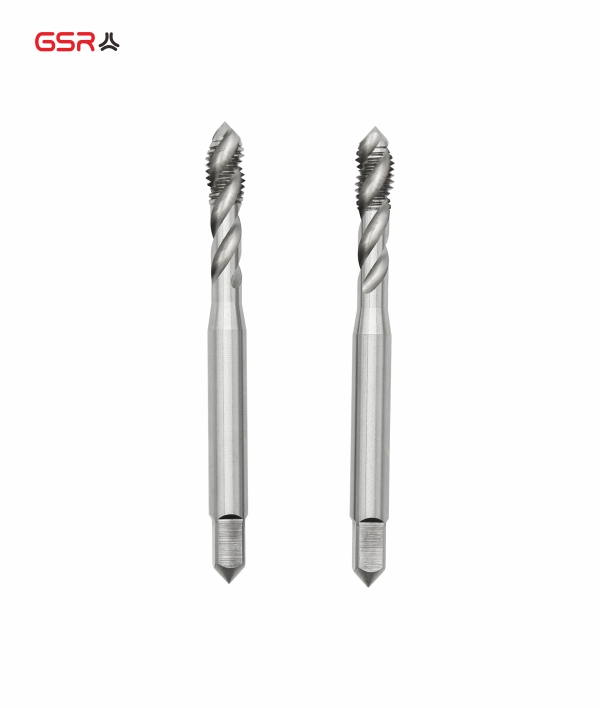
DIN371 machine tap, spiral flute RSP40°, M3-4-5-6-8-10, HSS, bright
DIN376 machine tap, spiral flute RSP40°, M12, HSS, bright
DIN338 twist drill bit, 2.5-3.3-4.2-5-6.8-8.5-10.2mm, HSS, Vaporized
Set 3
DIN371 machine tap, spiral point, M3-4-5-6-8-10, HSSE-M35, bright
DIN376 machine tap, spiral point, M12, HSSE-M35, bright
DIN338 twist drill bit, 2.5-3.3-4.2-5-6.8-8.5-10.2mm, HSSE-M35, Amber Finished
Set 4
DIN371 machine tap, spiral flute RSP40°, M3-4-5-6-8-10, HSSE-M35, bright
DIN376 machine tap, spiral flute RSP40°, M12, HSSE-M35, bright
DIN338 twist drill bit, 2.5-3.3-4.2-5-6.8-8.5-10.2mm, HSSE-M35, Amber Finished
A Comparison of the Performance of Taps Made from Two Different Materials
| HRC | For taps: 61-63HRC | For taps: 63-65HRC |
| Red Hardness | Average. Suitable for standard cutting operations, but its hardness decreases rapidly under the high temperatures (600°C) generated during high-speed, heavy-duty cutting. | Significant advantage. After operating at a high temperature of 625°C for four hours, it still maintains a high hardness of 63–65 HRC. |
| Wear Resistance and Toughness | Good toughness and thermal plasticity; average wear resistance | It offers excellent wear resistance, far exceeding that of standard high-speed steel, whilst maintaining good toughness, which helps prevent chipping. |
| Applications | Tools subjected to impact forces, such as twist drills, taps and end mills; also used in cold-work dies and general-purpose cutting tools. Suitable for machining medium- to low-hardness metals such as iron, copper and aluminium alloys. | Machining of high-strength and difficult-to-machine materials, such as high performance taps, hobs, broaches and reamers; as well as high-grade punching dies and cold forging dies. We specialise in particular in machining stainless steel, cast iron and similar materials. |
| Price | Relatively inexpensive and a standard material | It is relatively expensive, as the inclusion of the strategic metal cobalt significantly increases the cost |
| Shortcomings | High-temperature performance and wear resistance are relative weaknesses; it is not suitable for prolonged, heavy-duty machining | Its strength and impact toughness are slightly lower than those of 6542, and it is prone to oxidation and decarburisation, thus requiring more stringent heat treatment processes |
The precision of our machine taps: ISO2/6H
ISO 2/6H comprises two distinct sets of standards: one defining the manufacturing accuracy of the tap itself, and the other defining the tolerance class of the internal thread it can produce.
ISO 2 — Accuracy class of the tap itself
Meaning: Indicates the position of the tolerance zone for the tap’s pitch diameter; this corresponds to standard accuracy (medium fit).
Explanation: ISO stands for International Organisation for Standardisation. The number 2 is a grade designation, indicating that the manufacturing tolerance range of the tap itself is standard. It determines the tap’s position within the standard size range.
Correlation:
ISO 1 (4H): High precision, for tight fits
ISO 2 (6H): Standard precision, for standard fits
ISO 3 (6G): Coarse precision, for loose fits or where subsequent coating is required
6H — Tolerance class for machined internal threads
Meaning: Indicates the tolerance class of the internal thread that can be machined using this tap
Explanation: This section specifies the standard for the finished threaded hole. ‘6’ denotes the tolerance class, and ‘H’ denotes the basic deviation. A hole tapped using an ISO 2/6H tap will have a thread accuracy conforming to the 6H class, which is a very common standard fit class for metric threads.
Summary
The designation ‘ISO 2/6H’ can be fully understood as follows: this is a tap manufactured to ISO precision class 2 (standard precision), capable of consistently producing standard internal threads with a thread accuracy of 6H (standard fit).
Matching internal and external threads
In the international trade of standard parts, the 6H internal thread is best paired with the 6g external thread; this is what we often refer to as the ‘perfect match’.
There is another practical consideration behind the design of the 6g external thread: its mean diameter is slightly smaller than the theoretical standard for 6H (with a negative tolerance).
This allows for subsequent surface treatments (such as galvanising or blackening), ensuring that the screw dimensions fall precisely within the optimal fit range after plating, without the risk of the screw failing to screw in due to an excessively thick coating.
Other available accuracy levels and suitable applications
| Combination | Accuracy performance | Suitable scenarios | A simple explanation |
| 6H/6g | Standard fit | Standard machinery, general-purpose components | Standard and universal |
| 6H/6h | Zero-clearance fit | Precision instruments requiring high positioning accuracy | The screw is slightly too thick; it feels a bit tight when fitted with a 6H bit, so please check the fit. |
| 6H/5g | closer alignment | Equipment subject to severe vibration (requiring anti-loosening measures) | The screw is slightly thinner, resulting in a smaller clearance |
The choice of material depends on what you’re cutting and how durable it needs to be.
Choose 6542: If you are carrying out standard machining operations on a limited budget, primarily working with common metal materials, and require tools with good toughness that are resistant to breakage, then 6542 is a reliable and cost-effective choice.
Choose M35: If you are machining stainless steel or high-strength steel, require prolonged, high-efficiency cutting, or are experiencing rapid tool edge wear, investing in M35 is definitely worthwhile. Its superior durability delivers better machining quality and reduces downtime for tool changes.