




Threading Dies Knowledge
Basic Introduction
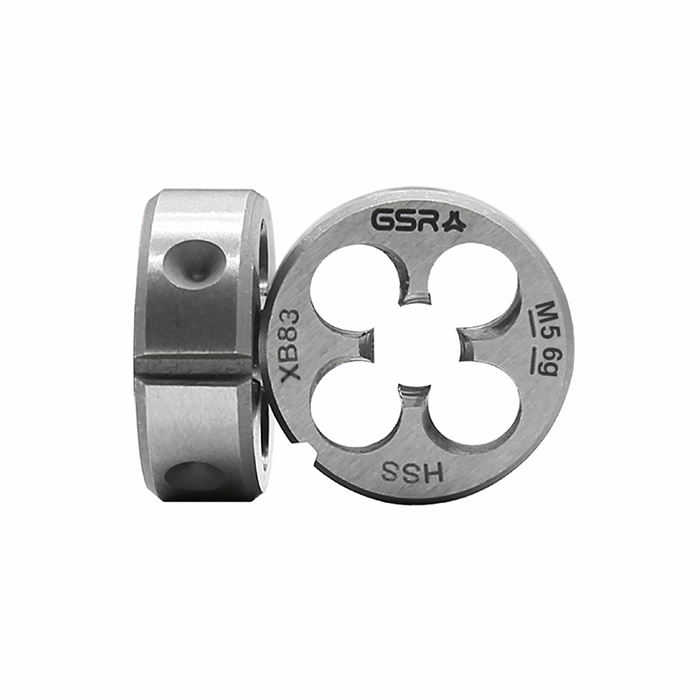
A threading die is essentially a nut made of high-hardness material (like High Speed Steel), with several chip ejection holes around the threaded hole. Typically, cutting tapers are ground at both ends of the threaded hole. Threading dies are classified by shape and application into round dies, square dies, hexagonal dies, and pipe dies (see figure: Types of Threading Dies). Among these, round dies are the most widely used, with a specification range of M0.25 to M68 mm. If the pitch diameter of the machined thread exceeds the tolerance, the adjustment slot on the die can be cut open to adjust the pitch diameter. Dies can be mounted in die stocks for manual thread cutting or in die holders for use on machine tools. Threads produced by dies have relatively low accuracy, but due to their simple structure and ease of use, dies are still widely used in single-piece, small-batch production, and repair work.
Classification Overview
Threading dies are classified by shape and application into round dies, square dies (four-square dies), hexagonal dies (hexagon dies), pipe dies, and tube dies. Among these, round dies are the most widely used, with a specification range of M0.25 to M68 mm. National standards exist for both round dies and hexagonal dies, but generally, only round dies are readily available in the hardware market; hexagonal dies are difficult to find, let alone square dies. Since square dies (Figure 1) lack a national standard, there are even fewer manufacturers, and their appearance also varies. However, square dies are very useful in machine maintenance and installation. For example, during machine tool installation, the threads on foundation bolts are often prone to damage. Most workshops only have round dies, which require a die holder for threading. Die holders are very large and occupy significant space, making threading at the machine foundation location impossible. In such cases, simply modifying the round die into a square die on a grinding wheel suffices, after which an adjustable wrench can be used for threading. Our unit once overhauled nearly 50 machine tools. Due to improper installation, a large number of foundation bolt threads were damaged, and this method was used for threading them.
Precautions
1. First, machine a 45-degree chamfer on the end of the bolt blank to prevent sudden loading on the die's lead-in threads. Also, ensure the round die or hexagonal die cuts into the bolt blank vertically.
2. Minimize the diameter of the bolt blank as much as possible, i.e., ensure the tolerance related to the major diameter of the bolt is near the lower limit. This reduces the cutting force generated during threading.
3. Use dies with a rake angle section to ensure chips are expelled from the cutting area.
4. Use the correct cutting fluid and direct an adequate amount of it towards the cutting area.
5. When adjusting an adjustable die, do not open it wider. An opened die will scrape rather than cut the workpiece during threading. Tighten the adjustment screws evenly to close the adjustable die by approximately 0.15 mm. If pressure is applied only to one side of the die, it may cause damage to the die.

For more information, visit us at WWW.GSR.TOOLS
Email us at sales@gsrthreads.com